Key Takeaways:
- Intermapper is expanding beyond traditional network monitoring to help IT teams see what is happening, understand why issues occur, and plan for what comes next.
- The broader Intermapper portfolio now includes specialized products for reporting, network traffic analysis, deeper server performance insight, forecasting, risk analysis, and capacity planning.
- Products and capabilities have been reorganized within the Intermapper portfolio. Vityl Capacity Management (VCM), Automated Analytics for Intermapper, and Intermapper Flows capabilities now align with different parts of the current product family.
- The new product structure is designed to make it easier to choose the right level of visibility and analysis without requiring every organization to use every Intermapper product.
- The overall direction is a shift from reactive monitoring toward more proactive infrastructure management — helping teams identify issues, investigate causes, communicate performance, and anticipate future needs.
Intermapper has long been known for making network monitoring straightforward: discover devices, build live network maps, monitor infrastructure health, and get alerted when something goes wrong.
That foundation isn't going away.
But today's IT teams need answers to more than one question.
They need to see what's happening across their entire infrastructure. They need enough context to understand why performance problems are happening. And increasingly, they need the information and analysis to plan what comes next before capacity, performance, or infrastructure issues become incidents.
That's the direction behind the new Intermapper product changes.
Intermapper Is Now a Broader IT Infrastructure Monitoring and Intelligence Solution
We’re bringing together the strengths of Intermapper and Vityl Capacity Management (VCM) under one product family. The result is a clearer progression:
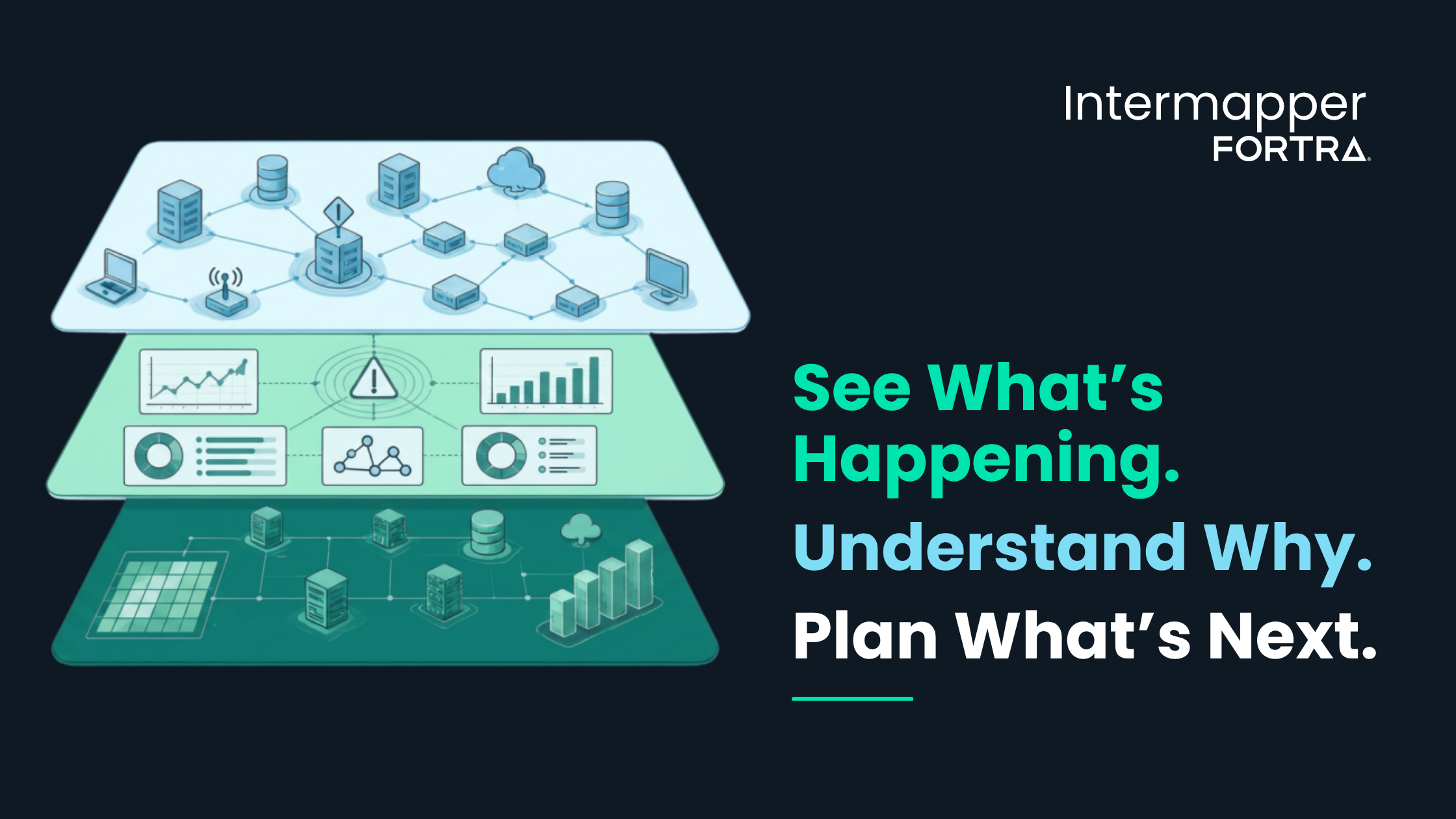
See What's Happening. Understand Why. Plan What's Next.
At the center is the network and server monitoring experience Intermapper customers already know. Around that foundation are specialized products that allow organizations to go deeper when they need additional traffic, server, reporting, analytical, or forecasting capabilities.
The current Intermapper product portfolio includes:
- Intermapper Network & Server Monitoring for live infrastructure visibility, network mapping, monitoring, alerts, and outage detection.
- Intermapper Advanced Reporting for operational reporting, executive visibility, SLA reporting, and automated report distribution.
- Intermapper Flows Insight for bandwidth monitoring, traffic analysis, NetFlow visibility, and understanding network utilization.
- Intermapper Server Insight for deeper server, platform, workload, and performance analysis.
- Intermapper Foresight for risk analysis, trends, forecasting, capacity planning, and forward-looking infrastructure decisions.
The goal isn't to make Intermapper more complicated. It's to give IT teams a path from monitoring a problem to understanding it and ultimately getting ahead of the next one.
Is Intermapper Still the Network Monitoring Product I Know?
Yes.
What is now called Intermapper Network & Server Monitoring represents the core monitoring and mapping capabilities historically associated with Intermapper.
It provides live network mapping, device and server monitoring, status visibility, alerts, and the ability to identify where infrastructure problems are occurring.
If your primary goal is to answer questions such as:
- Is this device up or down?
- Where is the problem occurring?
- What does my network look like right now?
- Which devices and servers require attention?
- Can I discover and map infrastructure automatically?
Intermapper Network & Server Monitoring remains the starting point.
The larger change is that Intermapper no longer stops there.
Why Has the Intermapper Portfolio Expanded?
IT infrastructure has become increasingly difficult to understand through availability monitoring alone.
A device can be online while users are experiencing poor performance. A network connection can be functioning while bandwidth consumption creates congestion. A server can be available while its workloads are under resource pressure. Infrastructure can appear healthy today while utilization trends are moving toward a future capacity constraint.
Different IT tools have traditionally answered each of those questions separately.
The new Intermapper direction is designed around the progression an IT team actually follows when managing infrastructure:
1. See What's Happening
First, identify the state of the environment.
Intermapper Network & Server Monitoring provides live maps, device and server health information, alerts, and outage visibility.
2. Understand Why
Next, add the context necessary to investigate what is driving an issue.
Intermapper Flows Insight looks at traffic and bandwidth behavior. Intermapper Server Insight provides deeper server, platform, workload, and source-level performance information. Intermapper Advanced Reporting turns infrastructure information into structured operational, SLA, and stakeholder reporting.
3. Plan What's Next
Finally, use historical information, trends, risk indicators, correlations, and forecasts to make decisions before a potential problem becomes urgent.
That's the role of Intermapper Foresight.
Together, those three stages give organizations a way to move from reactive monitoring toward more proactive infrastructure management.
What Happened to Vityl Capacity Management (VCM)?
Customers familiar with Vityl Capacity Management, or VCM, may recognize many of its concepts in the expanded Intermapper direction.
VCM was designed around performance data collection, infrastructure analysis, reporting, risk identification, resource optimization, and capacity planning.
VCM isn’t simply being given one new product name—its capabilities are becoming part of the broader Intermapper portfolio.
In the new structure, those needs are separated more clearly by the use case or job an IT team is trying to accomplish.
Deep infrastructure and workload performance visibility aligns with Intermapper Server Insight.
Risk identification, correlation, trends, forecasting, and capacity planning align with Intermapper Foresight.
This structure makes it easier for organizations to start with the capability they need rather than treating performance monitoring, analysis, and capacity planning as one large category.
What Happened to Automated Analytics for Intermapper?
The same principle applies to Automated Analytics for Intermapper.
Automated Analytics previously extended Intermapper monitoring data with capabilities such as automated analysis, forecasting, anomaly identification, custom reporting, dashboards, scheduling, and report distribution.
Those use cases have not disappeared from the Intermapper direction.
Instead, they fit more naturally within two areas of the current portfolio.
Intermapper Advanced Reporting focuses on transforming monitoring information into repeatable operational, SLA, executive, and custom reports and distributing that information to the people who need it.
Intermapper Foresight focuses on analysis that helps organizations interpret risk, correlations, trends, and future capacity needs.
Separating those jobs makes the distinction clearer: Advanced Reporting helps communicate what your data says and Foresight helps determine what your data could mean for what happens next.
What Happened to Intermapper Flows?
The traffic-analysis capabilities previously associated with Intermapper Flows continue as Intermapper Flows Insight.
Intermapper Flows Insight complements traditional network monitoring by examining the traffic moving across the network—not simply whether the underlying devices are available.
That gives network teams visibility into bandwidth usage, traffic patterns, top talkers, applications, communication flows, and unusual utilization so they can better understand why network performance has changed.
Do I Need Every Intermapper Product?
No.
The new portfolio is not based on the idea that every customer needs every capability.
Instead, organizations can match their Intermapper environment to the questions they need to answer for their specific use case.
If you primarily need real-time maps, alerts, availability, and network or server health, start with Intermapper Network & Server Monitoring.
If you need to determine what is consuming bandwidth, add Flows Insight.
If you need deeper server and workload performance context, use Server Insight.
If you need structured operational, executive, or SLA reporting, use Advanced Reporting.
And if you want to analyze risk, recognize trends, forecast capacity requirements, and make more proactive infrastructure decisions, Foresight extends the environment into forward-looking planning.
What Does This Mean for Existing Intermapper and VCM Customers?
The most important thing to know is that the Intermapper direction is an expansion of what the solution can help IT teams accomplish.
Live network visibility remains fundamental.
But infrastructure teams increasingly need to move beyond knowing that something changed. They need to understand what caused the change, communicate its impact, and recognize patterns early enough to do something about them.
That's why the Intermapper solution now spans monitoring, reporting, traffic analysis, deeper server intelligence, and forecasting.
Instead of stopping at:
“Something is wrong.”
Intermapper is being built to help answer:
What's happening?
Why is it happening?
What should we do next?